
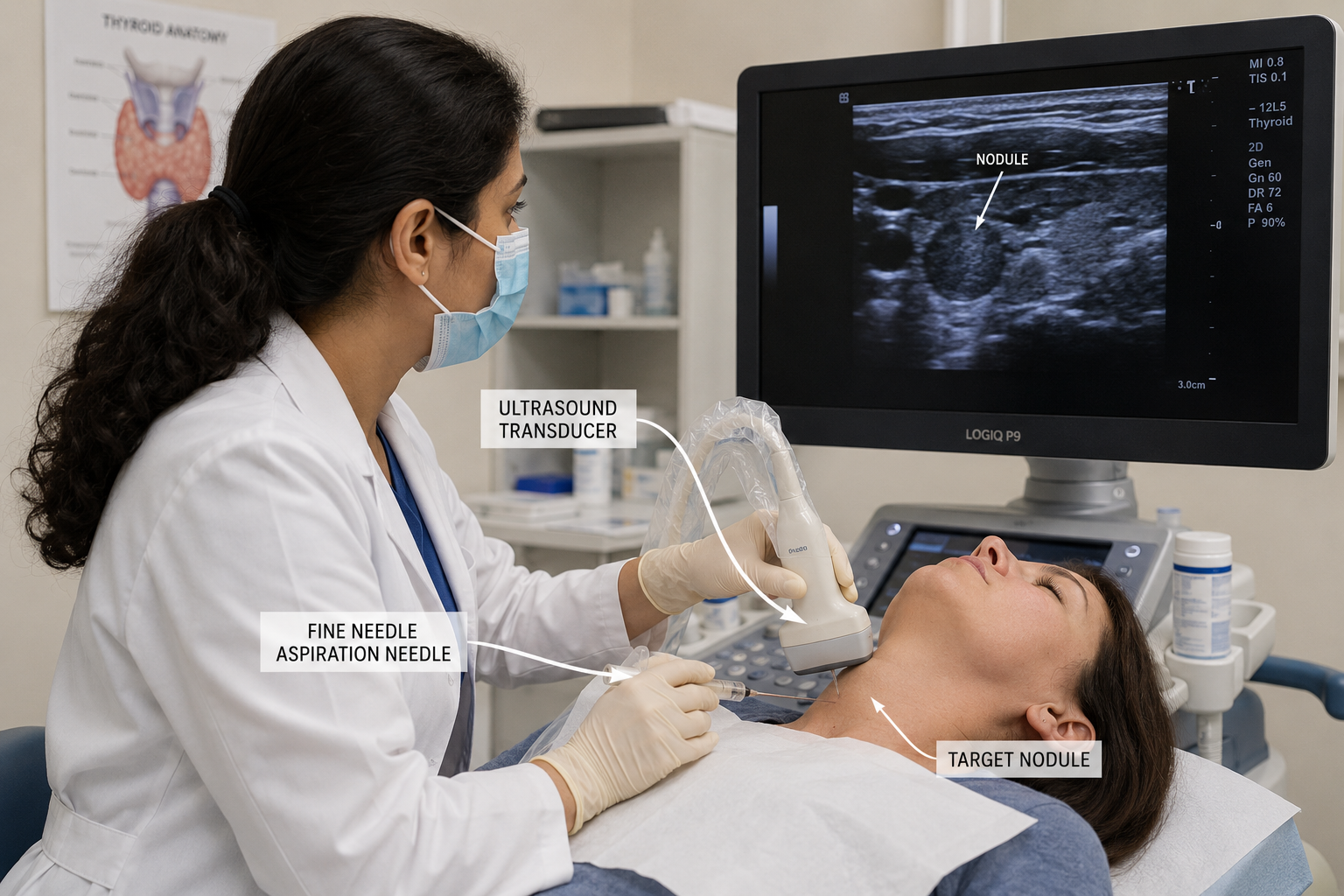
Ultrasound-Guided Fine Needle Biopsy (FNA)
Fast, Precise, Minimally Invasive Biopsy with On-Site Pathology Expertise
When you or your physician discovers a thyroid nodule, enlarged lymph node, neck mass, salivary gland mass, or other suspicious lump, getting an accurate diagnosis is the next important step.
Our ultrasound-guided fine needle biopsy (FNA) service combines real-time ultrasound imaging with the expertise of a pathologist to obtain the tissue needed for an accurate diagnosis—all through a minimally invasive procedure using a very thin needle.
Unlike a surgical biopsy, an ultrasound-guided FNA typically requires no incision, no stitches, and minimal recovery time.
Why Choose Our Ultrasound-Guided FNA Service?
Our approach brings the biopsy procedure and pathology expertise together.
Precision Ultrasound Guidance
Real-time ultrasound allows the physician to visualize the abnormality and accurately guide the needle into the area that needs to be sampled.
Pathology Expertise at the Time of Your Biopsy
Your specimen can be evaluated for adequacy during the procedure when appropriate. This helps determine whether sufficient diagnostic material has been collected before you leave.
Fewer Unnecessary Repeat Procedures
Obtaining an inadequate sample can sometimes mean returning for another biopsy. On-site evaluation is designed to help maximize the likelihood that adequate material is obtained during your visit.
Specialized Testing When Needed
Depending on the type of lesion and the initial findings, material can be appropriately collected or preserved for additional diagnostic studies such as immunohistochemistry, flow cytometry, or molecular testing.
Minimally Invasive and Convenient
Fine needle aspiration uses a very thin needle and generally allows patients to return to normal activities quickly.
Thyroid Nodule Biopsy
Thyroid nodules are common, and most are benign. However, certain nodules may need to be sampled to determine whether additional treatment or follow-up is necessary.
An ultrasound-guided thyroid FNA biopsy allows the physician to precisely target a thyroid nodule and collect cells for microscopic examination.
Ultrasound is particularly valuable when thyroid nodules are small, difficult to feel, or contain different solid and cystic areas.
If your endocrinologist, ENT physician, primary care physician, or other healthcare provider has recommended a thyroid nodule biopsy, ultrasound-guided FNA can provide important diagnostic information without surgery.
Lymph Node Biopsy
An enlarged or abnormal lymph node can have many possible causes, including infection, inflammation, and cancer.
An ultrasound-guided lymph node FNA biopsy allows suspicious lymph nodes to be targeted precisely while avoiding nearby structures.
When clinically appropriate, specimens can also be collected for specialized testing such as flow cytometry, which may be useful when evaluating certain lymphoid disorders.
Neck Mass and Salivary Gland Biopsy
We can also use ultrasound-guided FNA to evaluate many other abnormalities of the head and neck, including:
Parotid gland masses
Other salivary gland lesions
Enlarged cervical lymph nodes
Superficial neck masses
Selected soft-tissue masses
Other accessible abnormalities that can be visualized with ultrasound
Your physician and the pathologist can determine whether fine needle aspiration is appropriate for your specific condition.
What Is an Ultrasound-Guided Fine Needle Aspiration?
A fine needle aspiration biopsy, commonly called an FNA or FNAB, uses a thin needle to remove a small sample of cells from an abnormal area.
During an ultrasound-guided FNA, the physician watches the needle on an ultrasound screen in real time. This provides precise visualization of both the target and surrounding structures.
The collected cells are then prepared for examination under a microscope by a pathologist.
What Happens During an FNA Biopsy?
Your physician first examines the area with ultrasound and identifies the best location for sampling.
The skin is cleaned, and a thin needle is carefully advanced into the nodule or mass under direct ultrasound guidance. Cells are collected through the needle and prepared for microscopic examination.
Several passes may be performed to obtain enough material for a complete evaluation.
When appropriate, a portion of the specimen can be examined during the appointment to assess whether adequate material has been obtained.
The actual biopsy is generally brief and does not require a surgical incision.
The Advantage of On-Site Specimen Evaluation
One of the most important differences in our ultrasound-guided biopsy service is the availability of pathology expertise at the time of specimen collection.
A common challenge with needle biopsies is obtaining enough diagnostic material. If a specimen is inadequate, a patient may need another procedure.
When appropriate, we can perform an on-site adequacy assessment to determine whether the specimen appears sufficient for further diagnostic evaluation.
If additional material may be needed for specialized studies, that material can potentially be collected during the same visit.
The on-site assessment is not necessarily your final diagnosis. The final pathology report is issued after all required specimen preparation, microscopic examination, and additional testing have been completed.
Benefits of Ultrasound-Guided FNA
For appropriately selected patients, ultrasound-guided fine needle biopsy offers several advantages:
No surgical incision
No stitches
Real-time image guidance
Precise targeting of small nodules and masses
Minimal discomfort for most patients
Little or no downtime
No ionizing radiation from the ultrasound
On-site assessment of specimen adequacy when appropriate
Ability to obtain material for additional specialized testing when needed
Does a Fine Needle Biopsy Hurt?
Most patients tolerate FNA very well.
You may feel a brief pinch as the needle enters the skin and mild pressure or discomfort while the specimen is collected. Because FNA needles are very thin, discomfort is generally limited and short-lived.
Some patients experience mild tenderness or bruising afterward.
How Long Does an Ultrasound-Guided FNA Take?
The biopsy itself is usually relatively quick.
Your complete appointment may take longer because the physician needs time to review the area with ultrasound, prepare the biopsy site, obtain sufficient samples, and, when appropriate, evaluate the specimen for adequacy.
Our goal is not simply to perform the biopsy quickly. Our goal is to obtain the best possible diagnostic specimen during your visit.
What Should I Do Before My Biopsy?
Most patients require little special preparation.
Before your appointment, please tell us if you:
Take aspirin or other blood-thinning medications
Take anticoagulant medication
Have a bleeding disorder
Have allergies to medications or antiseptics
Are pregnant or may be pregnant
Have previously undergone a biopsy, surgery, radiation, or other treatment involving the area
Do not stop any prescription medication unless the physician managing that medication instructs you to do so.
We will provide additional instructions if they are necessary for your particular procedure.
What Happens After an FNA?
Most patients are able to resume their normal activities shortly after the procedure.
Minor soreness, bruising, or swelling can occur at the biopsy site and typically improves quickly.
You will receive instructions regarding care of the biopsy site and any precautions you should follow.
When Will I Get My Biopsy Results?
Although a pathologist may evaluate the specimen for adequacy during your procedure, a final diagnosis requires complete examination of the specimen.
Some cases require additional laboratory testing before a definitive diagnosis can be made.
Once the evaluation is complete, a final pathology report will be issued and your results will typically be discussed with you by your referring or treating physician.
Frequently Asked Questions About FNA Biopsy
Is an FNA the same as a needle biopsy?
Fine needle aspiration is one type of needle biopsy. It uses a very thin needle to collect cells for microscopic examination. A core needle biopsy uses a larger needle to obtain a small cylinder of tissue. Your physician will determine which type of biopsy is most appropriate.
Is an FNA the same as a surgical biopsy?
No. An FNA is minimally invasive and does not require a surgical incision. Some conditions may still require a core or surgical biopsy depending on the FNA findings and clinical circumstances.
Do I need anesthesia for a thyroid or lymph node FNA?
Because the needle is very thin, FNA is generally well tolerated. Whether local anesthetic is used depends on the location of the biopsy, the procedure being performed, and the physician's judgment.
Why is ultrasound used during the biopsy?
Ultrasound provides a real-time view of the nodule or mass and surrounding structures. This allows precise needle placement without exposing you to ionizing radiation.
Why does on-site pathology evaluation matter?
Evaluating the specimen during the procedure can help determine whether adequate material has been collected. When additional material is needed, it may be possible to obtain it before the procedure is completed rather than discovering an inadequate specimen after the patient has left.
Can you tell me whether I have cancer during the appointment?
Not necessarily. The purpose of an immediate assessment is primarily to evaluate the specimen and guide appropriate collection. A definitive diagnosis may require additional processing, microscopic examination, special stains, flow cytometry, molecular studies, or other testing.
Need a Thyroid, Lymph Node, or Neck Mass Biopsy?
If your physician has recommended a biopsy of a thyroid nodule, enlarged lymph node, parotid or salivary gland mass, neck mass, or another accessible abnormality, ask whether an ultrasound-guided fine needle aspiration biopsy is appropriate for you.
Our goal is to provide a precise, efficient, patient-centered biopsy experience while obtaining the high-quality diagnostic material your physician needs to guide your care.
Schedule an Ultrasound-Guided FNA
Your physician should send a referral to us, and once received and reviewed, our scheduling team will reach out to you. We will schedule your fine needle biopsy in one of our clinics.
Dover, DE
Lewes, DE
Rockville, MD
